Architecture
Runtime, host and application
A middleware runtime exports objects, discovers references, selects transports and dispatches calls. The application platform adds artifact verification, activation, generated component definitions and owned invocation lifetimes. A Nugget is the host in which these application and operational capabilities are assembled. Multiple JVMs run independently configured hosts.
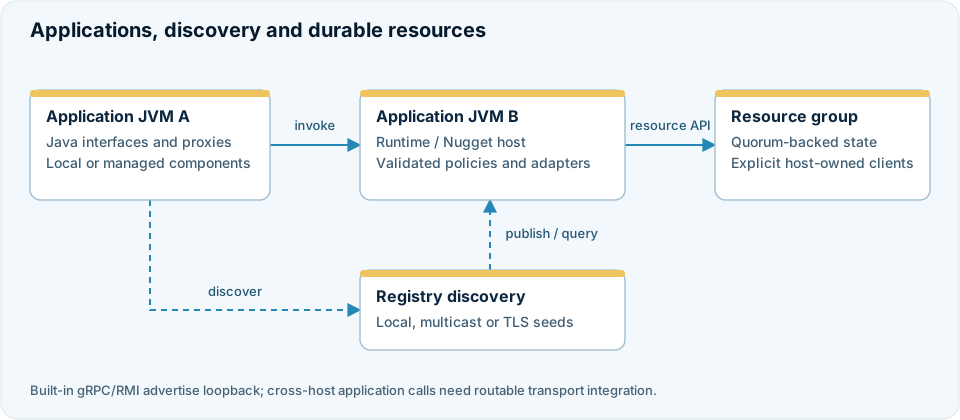
The built-in service transports advertise loopback endpoints. The diagram can run across JVMs on one machine; cross-host application invocation requires a routable transport integration, as explained in capability boundaries.
Discovery finds a suitable reference; the transport carries a call to that reference; the receiving runtime enforces admission and security. Optional distributed resource groups own their replicated state. These are distinct boundaries: finding a service does not prove that a later invocation will succeed.
Application components
The managed profile uses generated definitions rather than unrestricted reflection into an application's modules. The host validates configuration, resource bindings and policy identities before accepting work. Application code can use injection, lifecycle methods and annotated callbacks, while the host retains control over the facilities they select.
An invocation can finish logically before its physical work has stopped. A timeout or cancellation therefore does not immediately free a running task's resource ownership. Drain waits for tracked physical work before the application can be safely released. See lifecycle.
Optional distributed services
j7m-distributed-core provides quorum-backed resources, leases, fenced ownership,
replicated queues, durable jobs, sagas and retained events. The application
distributed module bridges these APIs to generated managed callbacks. The host
must explicitly install the clients, profiles and authorization required by each
feature.
Three and five voting JVMs are qualified development topologies, not a claim that an arbitrary number of application instances automatically forms a consensus group. Configure membership, storage, credentials and failure domains separately.
Evidence and next steps
The public boundaries are implemented in MiddlewareRuntime,
MiddlewareRuntimeBuilder, ApplicationManager, ManagedHostBindings and the
distributed client APIs. The detailed contract is owned by those implementations
and their tests; examples throughout this manual link to the relevant sources.