Request–reply and remote object references
Use case: an order frontend reads a price or obtains a reference to an order-specific remote object. Choose a small interface with bounded data values and a clear owner.
@RemoteService
public interface Pricing {
    @RemoteMethod
    @Deadline(millis = 750)
    long price(String product);
}
A managed service implementation and its generated metadata are admitted and exported by the application host.
try (ObjectRegistration<Pricing> exported = runtime.export(
        "pricing", implementation, Pricing.class, exportOptions)) {
    Pricing pricing = caller.lookup("pricing", Pricing.class, lookupOptions);
    long amount = pricing.price("book");
}
The runtime owns the export and proxy behavior. Closing the registration withdraws that export; closing the runtime releases its owned transport and registry resources.
Service name or exact reference?
Use a logical service lookup when any eligible instance may answer. Use runtime.reference(ref, Pricing.class, proxyOptions) when the operation must address a concrete runtime/object incarnation. A returned reference is a remote object identity, not copied application state or proof of authorization.
Configure and verify
Install a transport that is reachable through its advertised address, an appropriate registry path and authenticated server policy. Public interface visibility and codec allowlists still apply. See transports.
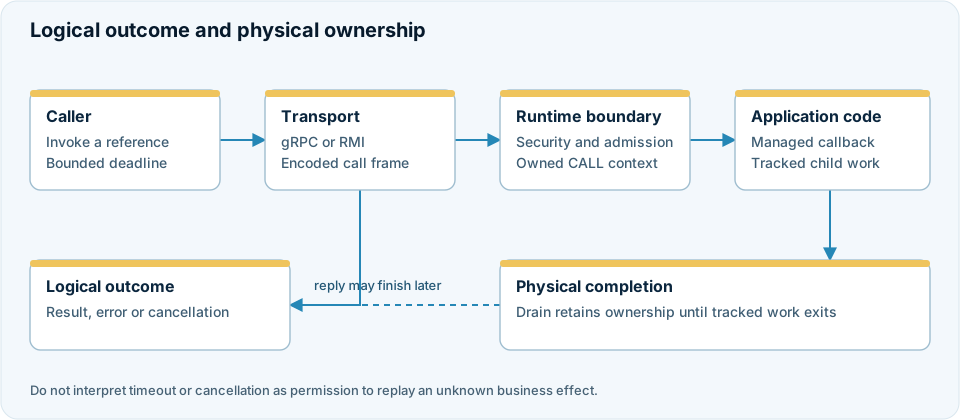
After a lost reply, a side-effecting operation may have executed. Do not assume a timeout means no effect. Introduce a stable business key and durable deduplication where the application needs a recorded repeat result.
Worked scenario: display a selected service's reply
The runnable manual application creates server and client runtimes with actual gRPC providers. They share one embedded registry store in one JVM. This isolates the invocation example from network discovery setup.
var options = new ExportOptions(false, "grpc", "default", List.of(),
        Map.of("region", "local"), null, null);
try (var registration = server.export(
        "greetings", new GreetingService(), GreetingApi.class, options)) {
    GreetingApi greeting = client.lookup(
            "greetings", GreetingApi.class, LookupOptions.defaults());
    String message = greeting.greet("Ada", callback);
    System.out.println(message);
}
GreetingService implements greet by returning "Hello, " + name and invoking the supplied listener. The callback example defines that listener. The client displays Hello, Ada. Closing the registration withdraws the export; it must remain alive for calls through that object.
Apply filters before invoking rather than silently selecting another region:
List<ObjectRef> matches = client.list("greetings",
        List.of(GreetingApi.class.getName()), Map.of("region", "other"),
        LookupOptions.defaults());
if (matches.isEmpty()) {
    System.out.println("No greeting service in the requested region");
}
The only export advertises region=local, so this branch reports that no matching service exists. Metadata selection remains separate from server authorization.
Run the complete application from the repository root:
./gradlew -I documentation/examples/compile.init.gradle documentationRunRuntime
Expected output includes RuntimeExample OK: two runtimes, actual gRPC, callback, filtered discovery. The application uses isolated development security; configure production TLS and discovery separately.