Service discovery and dynamic dependency replacement
Use case: checkout instances call one of several pricing instances. A newly started JVM should become eligible, and a failed target should not remain the permanent dependency of every checkout object.
J7M separates registry discovery from the stable business proxy. The host supplies a BindingCandidateSource, connector, contract constraints and admission policy. The built-in PolledBindingCandidateSource periodically repeats registry discovery; it is not an instantaneous topology notification service.
@Inject
public Checkout(@ServiceRef(name = "pricing",
        refresh = BindingRefresh.ON_FAILURE,
        policy = "pricing-client") Pricing pricing) {
    this.pricing = pricing;
}
ServiceBindingFactory resolves the generated dependency. The policy must be installed before activation.
List<ObjectRef> candidates = runtime.list(
        "pricing", List.of(Pricing.class.getName()),
        Map.of(), lookupOptions);
Pricing exact = runtime.reference(
        candidates.getFirst(), Pricing.class, proxyOptions);
This obtains an exact reference from the current list. An explicit application that wants continuous replacement must own a live binding/subscription and its lifecycle; repeatedly assigning an arbitrary field is not equivalent to the managed proxy contract.
Configure the discovery path
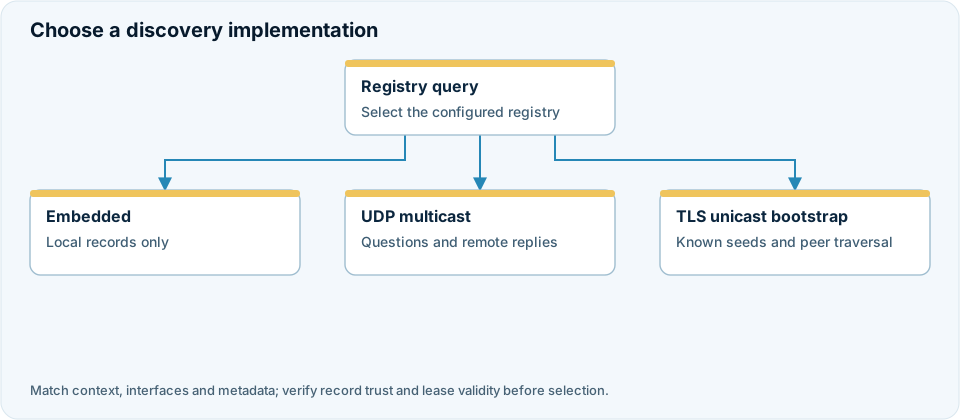
The default embedded registry is local to its store and does not discover unrelated JVMs. Select multicast for a reachable multicast domain, or explicit unicast TLS bootstrap seeds for routed networks. Match context and record trust. See discovery configuration.
NEVER selects once; ON_FAILURE keeps a healthy target; ON_TOPOLOGY_CHANGE can reselect on newer authoritative snapshots. Changing a target never replays the invocation that failed. Keep retry/deduplication decisions separate.
Failure and recovery
UNKNOWN discovery fails new calls closed. Stale generations cannot replace a newer accepted incarnation. Only qualified target/connection failures quarantine an incarnation; an ordinary business error is not proof that another instance should run the same operation.
Worked scenario: use a network registry with an unavailable seed
An operations team configures two authenticated bootstrap seed endpoints in the discovery configuration. The first can be temporarily unavailable; the second advertises eligible registry peers. Bound traversal depth, peer contacts, candidates and total deadline. Install the network resolver with the client's TLS credentials and trusted server material; strict publication trust is a separate check.
The application consumes the admitted candidates through the same typed dependency:
@J7mComponent
public final class Checkout {
    private final Pricing pricing;

    @Inject
    public Checkout(@ServiceRef(name = "pricing",
            refresh = BindingRefresh.ON_FAILURE,
            policy = "pricing-client") Pricing pricing) {
        this.pricing = pricing;
    }

    public String quote(String product) {
        return "Price: " + pricing.price(product);
    }
}
Assume Pricing.price returns a price string and the trusted host installs pricing-client. When the first registry seed is unreachable, traversal can reach the second and its peers within the original budget. Only records passing context, contract and publisher-trust admission become candidates. A valid TLS connection does not make every returned publication trustworthy.
A new pricing JVM can appear on a later discovery snapshot. ON_FAILURE keeps the current healthy target; ON_TOPOLOGY_CHANGE permits reevaluation when newer authoritative topology is accepted. If the selected JVM disappears, the failed invocation reports its outcome and a subsequent logical call can use a replacement. Do not resubmit an unsafe order command simply because discovery found another instance.